You know that moment when you’re standing at a jewellery counter, the salesperson is speaking in carats and clarity grades, and somewhere in the back of your head you’re doing mental math that makes absolutely no sense?
That’s where this conversation starts. Lab-grown diamond engagement rings aren’t new anymore. They’ve moved from “interesting concept” to “actually the thing half my friend group is buying.” And honestly? There’s a pretty solid reason for that.
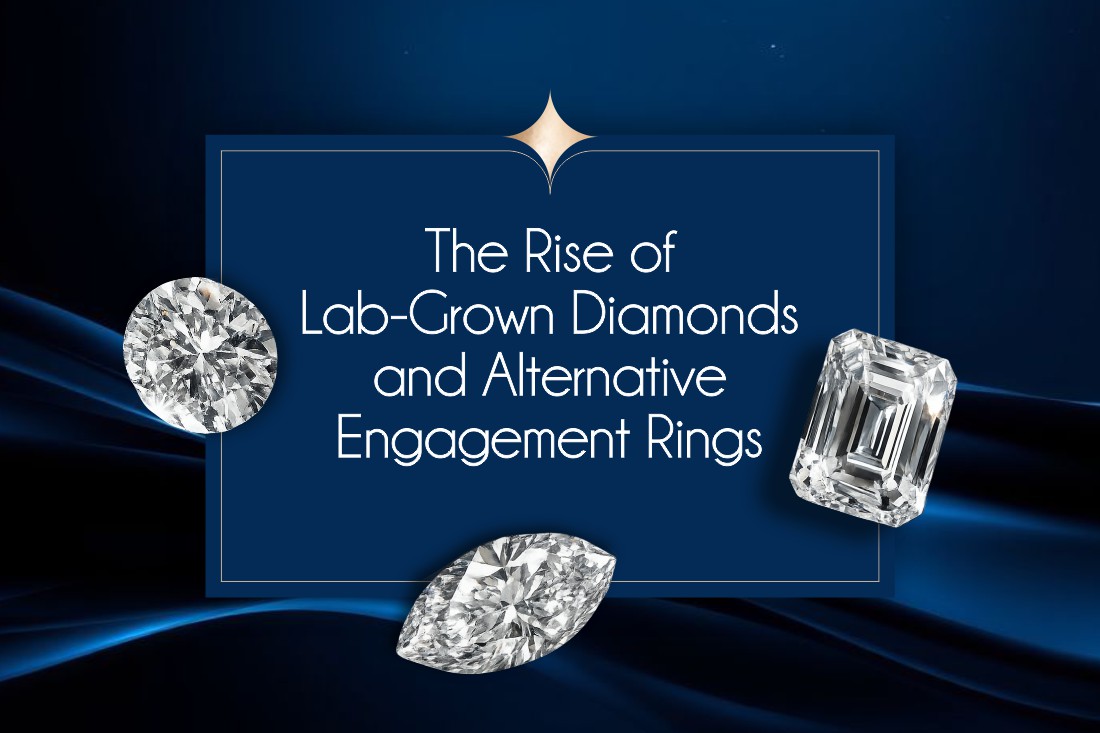
Why is everyone suddenly talking about Lab Grown Diamonds?
Here’s the deal: a lab grown diamond engagement ring is chemically, optically, and physically identical to one mined from the earth. The difference is where it came from and what it cost you.
On an average, lab-grown diamonds run anywhere between 50–70% cheaper than natural diamond engagement rings of comparable quality. So if you had a budget for a 1 carat engagement ring and were eyeing something classic, a lab diamond gets you there with money left over for the honeymoon or more rings, honestly.
How did this happen? Part of it is Hailey Bieber’s engagement ring moment when celebrity engagement rings started leaning into unique cuts and ethical sourcing, regular people started paying attention.
What about alternative engagement rings?
This is the part that gets genuinely interesting. While not everyone wants a big rock, lab-grown diamond or any other gemstone. Moissanite engagement rings are having a huge moment right now, for real.
Moissanite is a gemstone that ranks 9.25 on the Mohs hardness scale (diamond is 10), so it’s just incredibly durable for everyday wear, making it a masterpiece for working women. It’s just brilliant how moissanite refracts light differently and can look more sparkly to the naked eye, if you just look closely at it.
Beyond moissanite, there’s a whole world of gemstone engagement rings out there. Sapphire engagement rings have been cool ever since Princess Diana’s ring became the most talked-about proposal ring in history, and people are still going for that blue sapphire and diamond combo like it’s going out of style (it isn’t).
Ruby engagement rings, emerald engagement rings, even tanzanite engagement rings are brides’ favourite in 2026 are not afraid of colour.
How to find your perfect engagement ring?
One thing Wedding Asia exhibitors have really leaned into is custom engagement rings. When you walk into a stall and say “I want something with a pear-shaped diamond on a thin gold band with milgrain edges,” a good jeweller can build that for you.
Build engagement ring conversations are becoming common at every price point, from ₹30,000 to ₹3,00,000. The idea that a custom made engagement ring is only for the wealthy is kind of outdated now.
If you’re looking for the best engagement rings within a realistic budget, here’s an honest breakdown:
Under INR 50,000: Moissanite engagement rings, simple solitaire rings in sterling silver or 14k gold, lab engagement rings in smaller sizes.
Between INR 50,000–INR 1,50,000: Lab diamond engagement rings in the 0.5–1 carat range, sapphire engagement rings in white gold settings, unique oval engagement rings are available in this budget for your beloved.
INR 1,50,000 and above: You can shop for natural diamond engagement rings, certified diamond rings, designer pieces you’d find at exhibitions like Wedding Asia or premium jewellery shows in Delhi NCR.
Things to look for when buying a new ring
When you’re shopping, don’t just chase the stone, pay attention to the setting (just as you did when you were looking for the love of your life).
A halo engagement ring makes a smaller stone look bigger, good if you love the look but not the price of a 2 carat diamond. A cathedral engagement ring gives height and drama, and a bezel set engagement ring protects the stone and looks clean and modern.
Also, for heaven’s sake, check the certificate because a real diamond engagement ring should come with GIA or IGI certification. Lab made diamond engagement rings also get certified, so don’t let anyone tell you otherwise. If a seller can’t show you paperwork, walk away.
The bottom line is this: the engagement ring market in India is changing fast. Lab grown engagement rings, moissanite, and alternative stones are no longer compromise choices. They’re conscious ones, and increasingly, they’re the choice couples at places like Wedding Asia are proudly walking out with.
What about resale value?
Natural diamond engagement rings hold resale value but not as much as the industry once claimed, but they hold some. Lab created diamond engagement rings and moissanite engagement rings do not hold the same resale value.
So if you’re thinking of jewellery as an investment, natural diamonds (or gold, or polki) make more financial sense.
But here’s the counterpoint: most engagement rings don’t get sold because for obvious reasons, they are kept, passed down, or in some cases redesigned. If you’re buying with the intention of keeping it forever (and most people are) the resale argument matters less than you’d think.
The real question is what feels right for your relationship, your values, and your budget. An affordable engagement ring that actually fits your financial life is a better start to a marriage than a natural diamond that maxed out three months of savings?
FAQs
- What is the lifespan of a lab diamond?
Since they are identical to mined diamonds, lab grown diamonds show minimal measurable wear over a 50+ year wearing lifetime.
- Is a lab grown ring a real diamond?
Yes, absolutely. The lab grown diamonds are made of pure carbon crystallized in an isometric form, which makes them score a perfect 10 on the Mohs Hardness Scale, making them identical to a real diamond.
- What is the cost of 1 carat lab grown diamond ring?
One carat lab grown diamond ring usually costs around INR 40,000-INR 1,00,000 or more, depending on the cut, clarity and colour.